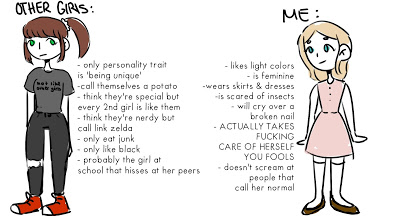
Are you the “cool girl” or are you the “other girl”? Or maybe you’re the guy that told a girl “you’re not like other girls, you’re cool!”.
Social media has drawn us further away from the “I” and has emphasized our relationship to the “me”. What the hell does that mean? Well… let ~Mead~ tell you!
American philosopher George Herbert Mead theorized that our interactions and socializations with others influences how we think about our-“self”. This idea of “self” toggles between what he names the “me” and the‘I”. The “me” is the cultivated idea of “self”. It’s the unique recipe of experiences and social interactions that makes up how we think of ourselves. It’s the part of you that internalized that “you’re not like other girls” comment from your middle school crush. Whereas the “I” is who you really are, your soul, your ego, your internal “self”.
It’s safe to say that this idea of “I’m not like other girls” developed in the pre-social media world. It is nearly innate to human nature to compare ourselves to one another. Whether it is in pre-social media world or the social mediatized world, this phenomenon happens purely out of a place of understanding the “me”. With the convenience of social media, we have the ability to compare ourselves to others at the palm of our hand.
The internalization of external interactions of the “me” has taken on a whole new level through maintaining a social media identity. Where societies interactions were subjective to people’s immediate environment, it is now open to endless amounts of virtual interactions through our online identity.
Girls can relate to the phrase “not like other girls”, because that’s what that one person said 10 years ago or we feel this way based of our own comparison to others.
We all know that girls are expected to behave and look a certain way. Our interactions with others and pop culture shapes this idea of traditional femininity. This shared ideology of what a woman or girl is supposed to look like is cultivated by our socialization with other women. As individuals we take all of these external factors in and reflect them as our “me”. The trope of “normal girls” and “other girls” derives from the rejection of these stereotypical gender roles.
If a girl doesn’t fit into the generalized standards of what it “is” to be girl, then they are categorized as the “other”. Essentially, this gets solidified to “not like other girls’ = good and “other girls” = bad. Many of these types of memes are from the perspective of the “other girl”.
So, instead of feeling like an outcast as the “other girl”, they chose to own it and identify with it as a part of their “self”. Kinda, sounds like a good thing, self-acceptance am I right?
When posts are made by the self-deprecating perspective by the “other girl”, it can be understood as the “I” breaking off from the “me” and claiming ownership to their identity. However, since one is just adapting to the identity that others gave them, then it is more of an illusion of finding the “I” than anything else. The true “I” seems to be nearly unreachable in this case.
Then a skskskssk and I oop, Tik Toc came along. What use to be #Notlikeothergirls memes escalated to videos and the generalization of different types of girl broadened to VSCO girls, E-Girls, and Soft Girls. This platform makes #Notlikeothergirls in parody videos where the “other girl” is like every other girl. In other words, the “normal girls” take ownership in being the “other girl”.
Wait, I thought the “other girl” = bad? Now the “cool girls” are rebelling against the “other girls” rebellion against stereotypes?
What happens to the “other girls” self-worth when it has become nothing but a parody? I don’t have an answer for it. However, you would expect it to depreciate but on the other hand, maybe it become oddly liberating that their whole identity is trending as a parody and that’s what “the cool girls” are doing now.
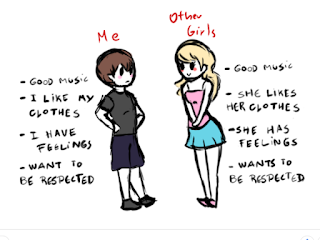
So who’s the “other girl” now? That’s right, there is no “other girl”.
The problem is that we all want to fit in but we also want to stand out and these are very contradictory goals.
Where societies interactions were subjective to people’s immediate environment, it is now open to endless amounts of virtual interactions. The internalization of external interactions of the “me” has taken on a whole new level through maintaining a social media identity.
This inevitably pulls people away from having a relationship to their “I” and creates obsession over fulfilling the “me”.
Girls nor boys should be generalized to be one or the other. There is not just one or the other. We can wear sneakers one night and heels the next. So, stop telling your middle school crushes “you’re not like other girls”. Obsess over finding your “I”, whatever that means to you.

 DIGITAL CATHARSIS