Tiger King: Cult-like Behavior on Social Media

Introduction

Hey all you cool cats and kittens!

Apparently, there is no better way to cope with a pandemic than with complete chaos. To say ‘it is weird times we are living in is an understatement. To make it even more weird, I have gathered data about how social media is responding to the Netflix docuseries Tiger King: Murder, Mayhem, and Madness (2020). Tiger King features several characters who walk the line between morality and legality, all of which cross the lines of both sides… and this is what people love about it. The magnitude of Tiger King’s virility doesn’t make much sense but neither does the toilet paper shortage. The theories of cults and social media have a lot more in common than we would think. This research reveals that the structure of social media happens to make up for the virtual barrier between a charismatic leader-follower relationship.

Literary Review

Tiger King Context

Tiger King: Murder, Mayhem and Madness says it all in the name. This true-crime Netflix docuseries takes us through the drama-filled, plot-twisting feuds of big cat zoo owners (2020). Most of the media commentating about the series is about Joe Exotic. He is a man of many things: a musician, political candidate, mullet head, polygamist, attention lovin’, Carole Baskin hatin’, and now incarcerated big cat zookeeper. If you haven’t seen it yet, it’s probably because you’ve gotten all you need to know off your social media feed. Joe Exotic has become somewhat of a cultural icon. People are obsessed, inspired, and raged to #FreeJoeExotic.  

While Joe Exotic has become the face most media, it is not to go without the discussion of Carole Baskin, essentially his arch nemesis. Carole Baskin is not only Joe Exotic’s rival but a huge player in the big cat industry. She runs her own zoo and is often in association with PETA who is against Joe Exotic’s care for tigers. To put it simple, they both feud about each other’s means of operation and it gets nasty. Joe Exotic’s living work shifted from loving and caring for the big cats to taking down Carole Baskin. Not to mention, there are also allegations that Carole Baskin murdered her missing, late husband. Joe Exotic uses these allegations to his defense while trying to take her down, but someone got to him first. Joe Exotic sits in prison while he grows in fame.

Structure of Social Media

The structure of social media allows us the tools to connect across geographical distances, bond over shared memories and communicate ideas. However, it is a platform that can unite us just as much as it can bring us apart. Our feeds are cultivated with the content that we give our attention to (Williams, 2019). In James William’s “Stand Out of Our Light”, he discusses that social media exists in a digital attention economy. In other words, social media monetizes the attention we pay to the content we consume (Williams, 2019). Naturally, we gravitate towards the ideologies that we identify with and then algorithms give us more of that. So, while the algorithms reinforce us with what we like see, the overarching narratives are pushing the polarization of societies ideologies (Williams, 2019).

There is not one definite reason why media becomes so spreadable or viral. In Spreadable Media: Creating Value and Meaning in a Networked Culture, Henry Jenkins argues that the gesture of sharing content is an act of interpersonal relationship (2013). Whether that is friendship-based or interest-based is subjective. The gesture of staring a piece of content is not always intentional. Jenkins echoes Douglas Rushcoff’s theory of media spreading like a virus (2013, p. 17). They both argue that when people share content, media is “spreading without the user’s conscious consent, people are duped into passing a hidden agenda while circulating content” (Jenkins, 2013). So rather than considering what the content means as a representation of their identity, or what agenda they are encouraging, they become a passive audience (Jenkins, p. 18). This also means that when people share viral content, they are more likely to share with the motives of gaining a social status (Jenkins, p. 13). People want to feel included in the mass narrative and they are willing to do that despite the message they are communicating as a result of their participation.

Historical Context

While considering the way people are communicating on social media and the structure of social media, it is especially important to consider the historical context. The Coronavirus (COVID-19) is an infectious disease that has spread across globe resulting in a life-altering pandemic. As the world has had to adapt to COVID-19 prevention strategies, 2020 has become a time of fear, anxiety, and panic (2020). According to the CDC, it is expected that people react to these stressful circumstances in unexpected ways (2020). Everyone’s life has changed, suddenly and drastically, in several ways. We can only assume that this has also affected how people are communicating and sharing media.

Cult Behavior

My initial interests were to find out why people are obsessing over Tiger King and going to the extremes to be a part of this bizarre trend. As I have looked further into this topic, I came across the YouTube video essay Joe Exotic: The Cult of Tiger King – Wisecrack Edition (2020). His research covers the evidence for how Joe Exotic, Doc Antle and Carole Baskin are essentially leaders of big cat cults (Wisecrack Edition, 2020). Psychiatrist and Harvard Professor Robert Jay Lifton’s paper: “Cult Formation”, explores the theoretical and historical development of “cults” (1991). Lifton defines cults to have three common characteristics, those being: 1) A charismatic leader, 2) Coercive persuasion or thought reform, 3) Exploitation of group members (1991). If you have seen Tiger King or have been on social media in the last month, I am sure the listed criteria triggered several cult-like instances within big cat operations.

However, the discussion is not whether Tiger King meets these cult criteria because that is obvious. I am particularly interested in whether this cult behavior- as exhibited in the show- has appeared over social media, why and what does that mean in the greater scheme of things. The psychology of cults provides some explanation to why people are so attached to Tiger King.

Intentions of the research

By narrowing down our focus on one case of potential cult-like behavior, it allows us to make assumptions about how society reacts to the media they are interacting with and processing in their everyday life. Whether it is Tiger King or politics, people rage and praise all the time. If you can see how the praising of Joe Exotic can be toxic, what does that say for the other type of media?

I am hypothesizing that the consumption of absolute chaos dilutes the current state of chaos people are existing in. The wild rampage of praising and raging about Tiger King on social media is at least a means of distractions and connection. Its crime filled-plot-twist nature offers excitement; something that these days seem to lack. However, there seems to be a deeper, underlying relationship. Considering the mental state of the world in the midst of a deadly pandemic, the structure of social media and the nature of viral spreadability, perhaps that makes for the perfect recipe to participate in cult-like behavior. If so, it would explain the loads of extreme Joe Exotic fandom. This may not meet the exact criteria of a cult since we are talking about a virtual medium. Although, this could be a new form cult behavior.

Method

Twitter was used to collect data for this research. The microblogging and social media network is home to “330 Million user and 145 million daily active users” (Oberlo, 2019). Twitter is also home to a plethora of Tiger King commentary data. I have performed a two-part data research process including both quantitative and qualitative research methods. First, I used a quantitative method to perform an advance search provided by Twitter’s platform to collect #FreeJoeExotic tweets over a 15-day period.  I gathered the first 10 tweets every other day starting from March 22, 2020 to April 6, 2020.

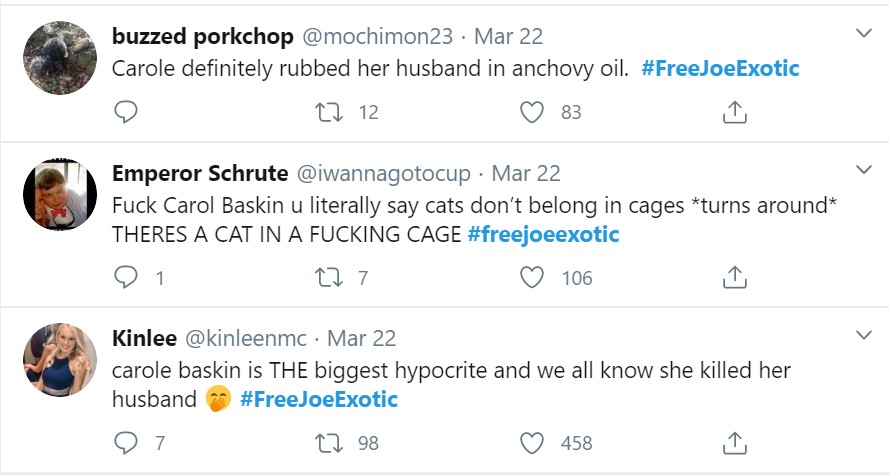
Once this data was collected, I organized and coded it into like categories. I found the coding to put thing into perspective but not reveal much on its own. At most, the coding results reaffirmed my assumptions that people are obsessed with Joe Exotic. I had expected that there would be more instances that rationally held Joe Exotic responsible for the crimes he has allegedly committed. Since this was not the case, it shows the popular narrative is siding with Joe Exotic and teaming up against Carole Baskin.

For my second part of data analysis, I used a qualitative method to find the similarities and differences of traditional cult behavior to the cult-like behavior performed by Tiger King fans on social media. The tweets discussed throughout the analysis are the most extreme cases from my collection. As cult are often extreme in devotion to their leader, I found my selection to be fitting for these circumstances (1991). Lifton’s definitions of cults provided a lens of cult criteria that situated the interpretation of my data (1991). Further, I pulled in social media theories to justify the similarities and differences found in traditional cults vs cult-like behavior online.

There is no evidence that this was the methodological best practice, however, there are some convincing elements to why I chose this method. First, I chose Twitter over other platforms because it is conveniently equipped with the advance search tool. This quality allowed me to search hashtags and specific dates that they were used. The time frame of my data selection covers the window from when #FreeJoeExotic was born through its apex and fall. Tiger King sat as Netflix’s #1 show for 15 days straight from March 22 to April 6; the days I collected data through. It important to recognize that the Most Popular List on Netflix feature was released on February 24, 2020 (Netflix). That is less than a month before the release of Tiger King. So, while Tiger King ran an intriguing streak, it is not all that significant considering the duration of the most popular feature.

Data search:

  1. Starting from March 22, 2020 to March 23, 2020
  2. Starting from March 24, 2020 to March 25, 2020
  3. Starting from March 26, 2020 to March 27, 2020
  4. Starting from March 28, 2020 to March 29, 2020
  5. Starting from March 30, 2020 to March 31, 2020
  6. Starting from April 1, 2020 to April 2, 2020
  7. Starting from April 3, 2020 to April 4, 2020
  8. Starting from April 5, 2020 to April 6, 2020

= Total of 80 tweets collected

 Research questions herein:

  1. Why is society using Tiger King (a depiction of complete chaos) to cope with COVID-19 (more chaos)?
  2. Is the obsession with Tiger King signs of cult-like behavior?
  3. Does the nature of social media influence cult-like behavior?

Data

Code Categories:

  1. Praising Joe Exotic: includes advocating for Joe Exotic, his release from prison, his brand i.e. G.W. Zoo, music, politics, etc.
    1. Total of 33 tweets
    1. 2 of which were extreme in the sense of comparing Joe Exotic to Jesus Christ
  2. Rescuing Joe Exotic: includes actual plans to #FreeJoeExotic, “me on the way to free Joe Exotic” memes, and references to celebs freeing Joe Exotic
    1. Total of 9 tweets
  3. Self-association with Tiger King: includes fan pics with Joe Exotic, pics with tigers, dressing up as Tiger King characters, Oklahoma natives
    1. Total of 8 tweets 
  4. Raging Joe Exotic: including negative connotation about Joe Exotic
    1. Total of 1 tweets
  5. Raging Carol Baskin: includes negative connotation about Carol Baskin
    1. Total of 25 tweets
  6. Advocating Animal Rights: includes commentary regarding advocacy for animal rights issues i.e. references to the tiger’s wellbeing
    1. Total of 2 tweets
  7. Neutral: includes neither fully praising or raging
    1. Total of 2 tweets

As you can see, out of all the data gathered, the Praising Joe Exotic was the most popular. If we grouped the categories Praising Joe Exotic, Rescuing Joe Exotic, Self-association, and Raging Carol Baskin, that is 74 out of 80 of the tweets think about Joe Exotic in a positive light. That is a shocking 92.5% of the tweets had discourse portrays Joe Exotic with positive connotation. These tweets are not all shown in one category because they communicated their advocacy for Joe Exotic in different ways. If you have been on social media in the pasted two months, these observations come as expected.

Analysis

We know that people love Joe Exotic, but this does not tell us much about the effects on social media. I have pulled together the different factors that may explain why people are reacting to Joe Exotic with intense admiration.These factors include what we know about the nature of social media, cult behavior and the historical context of covid-19. Going into this research we know that people are obsessed with Tiger King and based off convincing evidence, we are assuming that Joe Exotic, Doc Antle, and Carole Baskin, more or less, all ran their own forms of a cult to operate their zoos (Wisecrack Edition, 2020). By using these several factors to explain the obsession of Tiger King, we reveal that the intense admiration exhibited on social media could be a new form of a cult.

In the literary review, I introduced Lifton’s definition of a cult: “1) A charismatic leader, 2) Coercive persuasion or thought reform, 3) Exploitation of group members” (1991). While analyzing the data, I looked at it through the lens of this criteria and identified similarities and differences of traditional cult theory to cult-like behavior online.

Charismatic Leader

It is evident, by the virality of Joe Exotic, that we have ourselves some sort of a leader but is he charismatic? Lifton’s criteria specifically says “1) a charismatic leader who increasingly becomes an object of worship” (1991). To determine if Joe Exotic is a ‘charismatic leader’ we should first define what cult theory deems a ‘charismatic leader. In Narcissism and the Charismatic Leader-Follower Relationship, Jerold M Post says that:

Charismatic leadership is a relationship between a leader and a group of followers that has the following properties:

  1. The leader is perceived by the followers as somehow superhuman.
  2. The follows blindly believe the leader’s statements.
  3. The followers unconditionally comply with the leader’s directives for action
  4. The followers give the leader unqualified emotional support (1986, p. 676)

We will refer to this definition as we go through the examples. We should consider the unique circumstance of our ‘leader’ being in prison which greatly effects the dynamic of the leader to follower relationship. Despite the leader being in prison, the virtual medium alters how the charismatic leader and the followers’ function.

The tweets that stood out the most were those that were the most extreme forms of praising. For instance, this tweet by @itsvanessa_c12, shows a depiction of Joe Exotic’s face photoshoped onto Jesus Christ’s body.

This notion puts Joe Exotic- a man in prison for murder for hire and animal abuse- at the same hierarchy as a God. Referring to the properties of a charismatic leader, we can check off number one: leader perceived as superhuman (1986, p. 676).

Traditionally, in cults, the godly hierarchy of the charismatic leader is established by the leader and the followers are manipulated into believing this narrative (1986, p. 676). If we refer to the show, Doc Antel demands his workers to call him by the name ‘Bhagavan’ which translates to ‘Lord’ in Hindu. Okay so that’s pretty culty- no questions asked. Now, on social media, we have people voluntarily placing Joe Exotic on the same divine and holy pedestal.

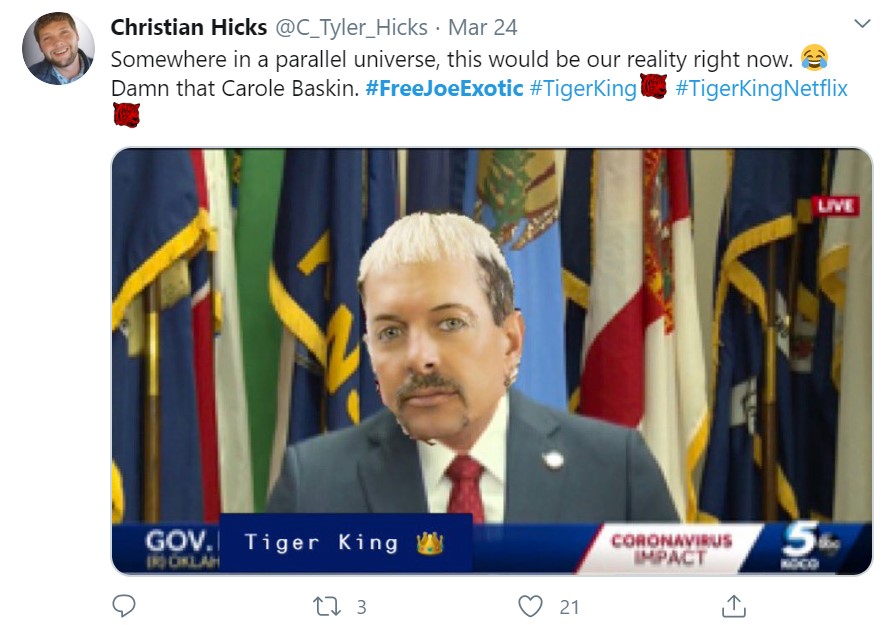
Of course, every tweet is not of Joe Exotic’s face photoshoped on Jesus’s body, but there are other extreme tweets that stood out to me, for instance, Joe Exotic as President.

Here, @C­_Tyler_Hicks tweets another photoshoped picture of Joe Exotic. This tweet must have been inspired by Joe Exotic’s legit run for presidency so, the idea was not completely influenced by the follower. While his verbiage indicates that this is meant to be taken as a joke, he still suggests that Joe Exotic as President would be a better alternative to the current circumstances.

What is significant about these two instances is that they are placing Joe Exotic in higher leadership and honorary positions than he holds. Whether these tweets are meant to be taken seriously or not, they still situate the idea of Joe Exotic as a charismatic leader. These examples are more extreme than most of the other media. However, it shows us the extent at which people will go to reward honor to public figures without the consideration of what the narrative means as a representation of their self. Rather than considering that the depiction of Joe Exotic as Jesus or the president is disrespectful to god, the president, and their followers, they mindlessly grant a false status.

In our circumstance, the structure of social media itself plays a huge role in the spreadability of Tiger King. The massive Joe Exotic bandwagon is influenced by the response to the documented media. There is no active leader manipulating people into their extreme devotion here. I am speculating that algorithms play a similar role to that of a charismatic leader of a cult. In the virtual medium, people should be more inclined and able to make their own decisions than in a physical cult. However, the virtual realm is equipped with psychological tools that have the potential to manipulate our attention, ideologies and values (Williams, 2019).

Algorithms acts as a developer’s tool to provide us with content that in turn, guarantees our eyeballs (Williams, 2019). The problem with algorithms is that they are designed to highlight bad content rather than good content for the sake of our attention (Williams, 2019). It is a fact that we are more notorious for giving our attention to bad. Negative narratives get 176% more attention than positive narratives (Forden, 2017). There are negative effects on both our individual and societal authorship as a result of our attention being manipulated towards ‘bad’ content (Williams, 2019). As individuals, it hinders our personal authorship (Williams, 2019). As a society, it disrupts the story of our collective authorship (Williams, 2019). The power to manipulate people’s sense of self, is nearly identical to that of a charismatic cult leader.

Thought Reform

According to Lifton’s definition, a charismatic cult leader participates in “2) the process of thought reform or coercive persuasion” (1991). Thought reform and coercive persuasion is the change in behavior, attitudes and/or ideologies influenced by a force of manipulation (Ofshe, 1999). Thought reform was very present in Tiger King. Wisecrack says that thought reform and persuasion is hard to pinpoint in Tiger King because we see the workers already acclimated into the culture, but this is the key point (2020). The workers are unquestionably devoted to their underpaid, 18 hour day jobs (Wisecrack, 2020). On social media, thought reform would be people’s unquestionable devotion to Joe Exotic and the mass narrative.

When people were not obsessing over Joe Exotic, they were most likely standing up for him by dogging on Carole Baskin. The most popular categories were Praising Joe Exotic at 35 tweets and Raging Carol Baskin at 22 tweets. We saw Joe Exotic preach his narrative in the docushort and we are seeing his followers stand behind him on social media, despite his absence. We saw a lot of people promoting the narrative that ‘Carole Baskin put Joe Exotic in jail’ or ‘Carole Baskin killed her husband’. However, the most disturbing tweets encouraged illegal behavior which theoretically, Joe Exotic would approve of. Most surprisingly, this tweet by @DomineekP is encouraging murder:

Some could argue that he was joking. Although, can’t you agree that murder is not really something to joke about? I would hope so. We should also consider that while the creator of the tweet may be joking, the interpretations of the tweet are subjective. So, what if someone took this seriously?  Praising Joe Exotic dismisses his wrongdoing and therefore promotes a skewed moral code. A skewed moral code could not only affect people’s ideologies, but I would expect it to effect people’s actions, outside of the virtual medium.

The entirety of the Tiger King trend reinforces the social acceptance of immoral actions. The show itself crosses the line of crime from drugs, to animal abuse to plans for murder. As a society we have been constructed and desensitized to accept this type of behavior from the movies see. The concern here is that we are not talking about Hollywood characters, we are talking about real people. Immoral narratives ultimately have the potential to alter what society deems as moral and immoral and this can have long term effects (Williams, 2019).

Don’t think that the structure of social media doesn’t go without a blame in this either. The media people experience is a result of cultivated content. Algorithms are used as persuasive tools to reinforce the popular narratives, often leading to polarization and overarching narratives (Williams, 2019). Polarization is radical, two-sided, black and white opinions or beliefs (Williams, p. 64). In effect, this drives people away from having a general will or a “common purpose” (Williams, p. 64). Williams agrees with Rousseau that this persuasive control “[subdivides] society into groups, which leads them to ‘abandon’ their ‘membership’ of the wider group.” (Williams, p. 64-65). In other words, the persuasive and manipulative structure of social media constructs a society that is susceptible to dividing and finding purpose in subgroups. He says that this division encouraged on the internet, acts as a “distorted reflection” of our identities and values (Williams, p. 65).

Post discusses this same theory of polarization in the context of cult theory (1986, p. 681). He says that this “we verse them” rhetoric is meant to “unify the populace against the outside enemy” (1986, p. 681). The majority narrative that Joe Exotic is good, and Carole Baskin is bad is exactly that of a polarized, “we verse them” agenda. The most popular categories in my data collection were situated off polarization. Over time, we begin to moralize the narratives algorithms feed us which inevitability “threatens our ability to know and define what our goals and values are…” (Williams, p. 65). Sound like thought reform?

Exploitation

Lifton’s third criteria: “3) economic, sexual, and other exploitation of group members by the leader and the ruling coterie” (1991). Exploitation is a little bit harder to define because it can come in many forms. In Tiger King we saw instances of sexual coercion, underpaid workers, and the mistreatment of tigers (2020). Exploitation is less present in our circumstances because we do not have an active charismatic leader-follower interaction happening. However, there are some questionable instances of self-exploitation happening.

The first instances of people exploiting themselves is, you guessed it, another photoshoped picture. @EthanTrueblood tweets a picture of his face over Joe Exotic’s husband’s face. By doing this he is essentially labeling himself as sexually available for Joe Exotic. Keep in mind, no coercion from a charismatic leader took place here.

In another tweet, @Captainkbob suggest we strip to save Joe Exotic. This was by for the most popular tweet I collected. This speaks for itself that people aren’t too opposed to the idea. Over and over again people are showing extreme devotion all by their own intentions.

In this new cult-like behavior, rather than a charismatic leader coercing people into subservient followers, people voluntarily self-associate as a follower. I coded 8 tweets of Self-association. These tweets in particular, went out of their way to let everyone know that they should be labeled as a Tiger King follower. It was as if by sharing photos with Joe Exotic or tigers, they were justifying their level of loyalty or long-term dedication. The tweets acted as a means of competing for being a real follower of Joe Exotic.

Social media is exploitation in the sense that we are being robbed our attention (Williams, 2019). Williams goes as far to say that the attention economy seeks to achieve the capture and exploitation of human desires, actions, decisions, and ultimately lives…” (2019). As people scroll their feed, they are bombarded with the overarching narrative of Tiger King, they feel the need to claim their place, so they drink the Kool aid.

Anthony F. C. Wallace coined the theory of revitalization movements (Bainbridge, p. 287). His research found that when societies experience a great load of stress, tragedy and/or threat, such as “epidemics”, they are susceptible to forming ‘crisis cults’ (Bainbridge, p. 287). In the processes of revitalizing their society, they find purpose and community in cult groups. Bainbridge claims that “cults are particularly likely to emerge wherever numbers of people seek help for intractable personal problems” (1979, p. 292). Further, he says that social acceptance is one step in the process of forming cults. In retaliation to polarization and not to mention covid-19, people seem to be clinging to the crazy Tiger King narrative as a ground for connection.

Both religions and cults are based off a reward system (1979, p. 284). Whether this be guaranteed life after death or cuddling tigers, there is always something that persuades a follower into staying. If Joe Exotic is unintentionally leading his own cult from prison, there would not be anything in it for the followers. However, if you remember, Jenkins argues that we share content on social media with the effort for interpersonal relationship. That can be either friendship-based or interest-based (2013). Perhaps the reward online is as simple as feeling included by a common narrative. People are always searching for their place in the world. It is evident that theories of cults and social media have a lot more in common than we would have suspected.

Conclusion

Before Tiger King went viral, people’s diction was less extreme, but as more people joined the Tiger King fandom, people started going to the extremes of idolizing Joe Exotic, dressing up like him, asking him to be our savior from the coronavirus and referring to him as a “national treasure”.  The tweets that stood out the most align with the characteristics in Lifton’s definitions of cults. Particularly, we saw followers praise Joe Exotic in extreme manners, advocated for immoral actions, and self-exploit. While Joe Exotic is sitting in prison, he has transitioned from a wanna-be celeb to an object of worship. The difference between an in-person cult and the cult-like behavior we are witnessing here is that, the leader is not manipulating people into acting this way; the followers are doing it all on their own and algorithms are encouraging it.

You would think that the structure of social media would hinder the effectiveness of cults, however, it seems to compliment it. If we refer to our first cult criteria, charismatic leader, we can recall that people voluntarily graced Joe Exotic with the honor of a god or the president. The second criteria, thought reform, we see a shift in moral integrity. The most extreme advocates for Joe Exotic to murder Carole Baskin verbatim. The third criteria, exploitation, looks a little bit different than what we would expect in traditional cults. Instead of the charismatic leader exploiting the group members, the followers voluntarily exploit themselves. In some ways, algorithms take the role of manipulation as a cult leader. This reveals that the structure of social media happens to make up for the virtual barrier between a charismatic leader-follower relationship.

The devotion of the Tiger King cult-like people is questionable. As we know it, it is only a trend that is bound to die. Still, I think these finding should be considered in further research. For instance, an analysis on how people responded to Joe Exotic’s Carole Baskin Saga on JoeExoticTV YouTube channel would give a gauge of how committed his followers are to his word. More importantly, these finding should be explored in more concentrated data with potential charismatic leader-follower relationship. It is concerning that cult behavior appeared as it did consider the absence of a charismatic leader being an active influence. The power of cult psychology and the structure of social media could breed some dangerous outcomes. My analysis may be a bit of a stretch, but like the obsession of Tiger King and the toilet paper shortage, nothing is making a lot of sense these days.

References

Bainbridge, W., & Stark, R. (1979). Cult Formation: Three Compatible Models. Sociological Analysis, 40(4), 283-295. doi:10.2307/3709958

CDC. (2020). How to Protect Yourself & Others. Retrieved from https://www.cdc.gov/coronavirus/2019-ncov/prevent-getting-sick/prevention.html

Fordon, C. (2017). Does Positive or Negative Press Coverage Bring More Benefits for Startups? Retrieved from https://www.business2community.com/public-relations/positive-negative-press-coverage-bring-benefits-startups-01943281

Goode, E.& Chaiklin, R. (Directors). (2020) Tiger King: Murder, Mayhem & Madness. [Docushort]. United States: Netflix.

Jenkins, H., Ford, S., & Green, J. (2013). Spreadable Media: Creating Value and Meaning in a Networked Culture. New York; London: NYU Press. Retrieved May 8, 2020, from www.jstor.org/stable/j.ctt9qfk6w

Lifton, R. (1991). Cult Formation. Retrieved from https://www.icsahome.com/articles/cult-formation-lifton-csj-8-1-1991

Lin, Y. (2019). 10 Twitter Statistics Every Marketer Should Know in 2020. Retrieved from https://www.oberlo.com/blog/twitter-statistics

Netflix. (2020). Now – for the first time – you can see what’s popular on Netflix. Retrieved from https://media.netflix.com/en/company-blog/see-whats-popular-on-netflix

Ofshe, R. (1999).  Coercive Persuasion and Attitude Change. Retrieved from https://culteducation.com/group/798-abusive-controlling-relationships/3260-coercive-persuasion-and-attitude-changes.html

Post, J. (1986). Narcissism and the Charismatic Leader-Follower Relationship. Political Psychology, 7(4), 675-688. doi:10.2307/3791208

Tassi, P. (2020) ‘Tiger King’ Has Been Netflix’s #1 Show For 15 Straight Days. Retrieved from https://www.forbes.com/sites/paultassi/2020/04/07/tiger-king-has-been-netflixs-1-show-for-15-straight-days/#5a616e5a7417

Williams, J. (2019) Stand Out of Our Light: Freedom and Resistance in the Attention Economy. Retrieved from https://www.cambridge.org/core/services/aop-cambridge-core/content/view/3F8D7BA2C0FE3A7126A4D9B73A89415D/9781108429092AR.pdf/Stand_out_of_our_Light.pdf?event-type=FTLA.

Wisecrack. (2020). Joe Exotic: The Cult of Tiger King – Wisecrack Edition. Retrieved from https://www.youtube.com/watch?v=Ri2Pmv9_iMk
The Not-so Lit Review

This is a draft of my lit review for my Tiger King research project. Stay tuned for the lit review in final product of my project.

Tiger King Context

Tiger King: Murder, Mayhem and Madness says it all in the name. This true-crime Netflix docuseries takes us through the drama-filled, plot-twisting feuds of big cat zoo owners. Most of the media commentating about the series is about Joe Exotic. He is a man of many things: a musician, political candidate, mullet head, polygamist, attention lovin’, Carole Baskin hatin’, and now incarcerated big cat zookeeper. Joe Exotic has become a somewhat of a cultural icon. People are obsessed, inspired and raged to #FreeJoeExotic.  

While Joe Exotic has become the face most media, it is not to go without the discussion of Carole Baskin, his arch nemesis. Carole Baskin is not only Joe Exotic’s rival but a huge player in the big cat industry. She runs her own zoo and is often in association with PETA. To put it simple, they both feud about each other’s means of operation and it gets nasty. Joe Exotic’s living work shifted from loving and caring for the big cats to taking down Carole Baskin. Not to mention, there is also assumptions that Carole murdered her missing, late husband. Joe Exotic uses this allegation to his defense while trying to take her down.

Structure of Social Media

The structure of social media allows us the tools to connect across geographical distances, bond over shared memories and communicate ideas. However, it is a platform that can unite us just as much as it can bring us apart. Our feeds are cultivated with the content that we give our attention to (Williams, 2019). Naturally, we gravitate towards the things we believe in. So, while the algorithms are reinforcing what we like to see, an overarching narrative takes over the internet.

There is not one definite reason why media becomes so spreadable or viral. Jenkins argues that the gesture of sharing content is an act of interpersonal relationship. Whether that is friendship-based or interest-based is subjective. The gesture of staring a piece of content is not always intentional. Jenkins echoes Douglas Rushcoff’s theory of media spreading like a virus (2013, p. 17). They both argue that when people share content, media is “spreading without the user’s conscious consent, people are duped into passing a hidden agenda while circulating content” (Jenkins, p. 17). So rather than considering what the content means as a representation of their identity, or what agenda they are encouraging, they become a passive audience (Jenkins, p. 18). This also means that when people share viral content, they are more likely to share with the motives of gaining a social status (Jenkins, p. 13). People want to feel including in the mass narrative and they are willing to do that despite the message they are communicating as a result of their participation.

Cult Behavior

My initial interests were to find out why people are obsessing over Tiger King and going to the extremes to be a part of this bizarre trend. As I have looked further into this topic, I came across the YouTube video Joe Exotic: The Cult of Tiger King – Wisecrack Edition (2020). His research covers the evidence for how Joe Exotic, Doc Antle and Carole Baskin are essentially leaders of big cat cults. Referring to Psychiatrist and Harvard Professor Robert Jay Lifton’s paper: Cult Formation, explores the theoretical and historical development of “cults” (1993). He defines cults to have three common characteristics, those being: 1) A charismatic leader, 2) Coercive persuasion or thought reform, 3) Exploitation of group members (1993). If you have seen Tiger King or have been on social media in the last month, I’m sure the listed criteria triggered several cult-like instances within big cat operations of Tiger King.

However, the discussion is not whether Tiger King meets these cult criteria because that is obvious. I am particularly interested whether this cult behavior- as exhibited in the show- has appeared over social media, why and what does that mean in the greater scheme of things. The psychology of cults provides some explanation to why people are so attached to Tiger King.

Historical Context

While considering the way people are communicating on social media and the structure of social media, it is especially important to consider the historical context. The Coronavirus (COVID-19) is an infectious disease that has spread across globe resulting in a life-altering pandemic. As the world has had to adapt to COVID-19 prevention strategies, 2020 has become a time of fear, anxiety, and panic. According to the CDC, it is expected that people react to these stressful circumstances in unexpected ways (2020). Everyone’s life has change, suddenly and drastically in several ways. We can only assume that this has also affected how people are communicating and sharing media.

Intentions of the research

I am hypothesizing that the consumption of absolute chaos dilutes the current state of chaos people are existing in. The wild rampage of praising and raging about Tiger King on social media is at least a means of distractions and connection. Its crime filled-plot-twist nature offers excitement; something that these days seem to lack. However, there seems to be a deeper, underlying message. Considering the mental state of the world in the midst of a deadly pandemic, the structure of social media and the nature of viral spreadability, perhaps that makes people are susceptible to participating in cult-like behavior. If so, it would explain some of the loads of extreme Joe Exotic fandom.

By narrowing down our focus on one case of potential cult-like behavior. It allows us to make assumptions about how society reacts to the media they are interacting and processing in their everyday life. Whether it’s Tiger King or politics, people rage and praise all the time. This may not meet the exact criteria of a cult since we are talking about a virtual medium. Although, maybe this could be a new form of a cult.

Data, Method, and Research Questions

Twitter was used to collected data for this research. The microblogging and social media network is home to “330 Million user and 145 million daily active users” (Oberlo, 2019). Twitter is also home to a plethora of Tiger King commentary data. I have performed a two-part data research process including both quantitative and qualitative research methods. First, I used a quantitative method to perform an advance search provided by Twitter’s platform to collect #FreeJoeExotic tweets over a 15-day period.  I gathered the first 10 tweets every other day starting from March 22, 2020 to April 6, 2020. Once this data was collected, I organized and coded it into like categories. Then I used a qualitative and rhetorical analysis to make conclusions based on the trends found throughout the discourse.

There is no evidence that this was the methodological best practice, however, there are some convincing elements to why I chose this method. First, I chose Twitter over other platforms because it is conveniently equipped with the advance search tool. This quality allowed me to search hashtags and specific dates that they were used. The time frame of my data selection covers the window from when #FreeJoeExotic was born through its apex and fall. Tiger King sat as Netflix’s #1 show for 15 days straight from March 22 to April 6; the days I collected data through. It important to recognize that the Most Popular List on Netflix feature was released on February 24, 2020 (Netflix). That is less than a month before the release of Tiger King. So, while Tiger King ran an intriguing streak, it is not all that significant considering the duration of the most popular feature.

Twitter Data searchs:

  1. Starting from March 22, 2020 to March 23, 2020
  2. Starting from March 24, 2020 to March 25, 2020
  3. Starting from March 26, 2020 to March 27, 2020
  4. Starting from March 28, 2020 to March 29, 2020
  5. Starting from March 30, 2020 to March 31, 2020
  6. Starting from April 1, 2020 to April 2, 2020
  7. Starting from April 3, 2020 to April 4, 2020
  8. Starting from April 5, 2020 to April 6, 2020

= Total of 80 tweets collected

Code Categories

  1. Praising Joe Exotic: includes advocating for Joe Exotic, his release from prison, his brand i.e. G.W. Zoo, music, politics, etc.
    1. Total of 33 tweets
    1. 2 of which were extreme in the sense of comparing Joe Exotic to Jesus Christ
  2. Rescuing Joe Exotic: includes actual plans to #FreeJoeExotic, “me on the way to free Joe Exotic” memes, and references to celebs freeing Joe Exotic
    1. Total of 9 tweets
  3. Self-association Tiger King: includes fan pics with Joe Exotic, pics with tigers, dressing up as Tiger King characters, Oklahoma natives
    1. Total of 7 tweets  
  4. Raging Joe Exotic: including negative connotation about Joe Exotic
    1. Total of 2 tweets
  5. Raging Carol Baskin: includes negative connotation about Carol Baskin
    1. Total of 25 tweets
  6. Advocating Animal Rights: includes commentary regarding advocacy for animal rights issues i.e. references to the tiger’s wellbeing
    1. Total of 2 tweets
  7. Neutral: includes neither fully praising or raging
    1. Total of 2 tweets

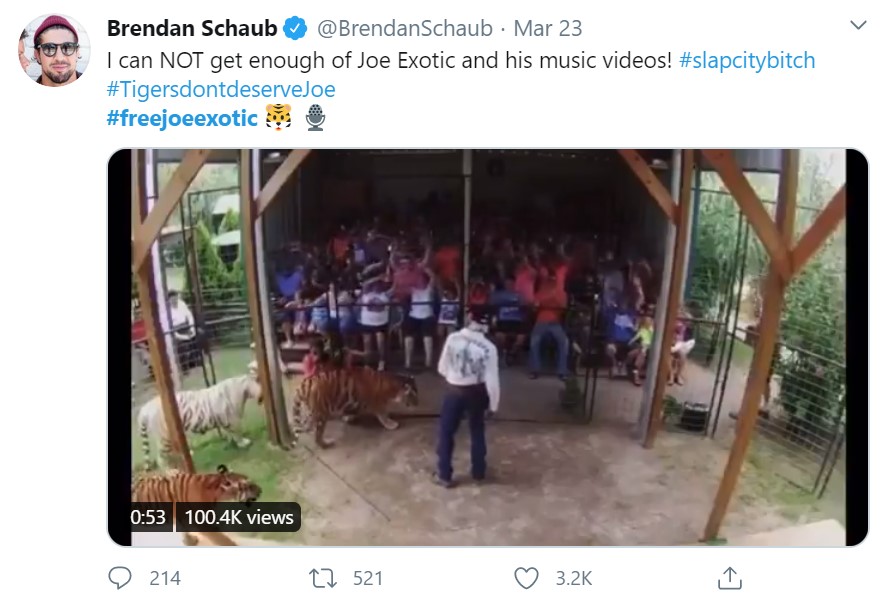
As I have gathered more data, as you can see, I have added a few more categories: Rescuing Joe Exotic, Self-Associating with Tiger King, and Raging Joe Exotic. The most surprising data I came across were the detailed plans of recusing Joe Exotic from federal prison. One featured a step by step plan of how to rescue Joe and another featured a detailed map of how to get sneak him out. I will discuses this in more detail in my final product. Also, I was not expecting to come across the tweets that compared Joe Exotic to Jesus Christ. People actually took the time to Photoshop Joe’s face over an art piece of Jesus.

Research questions herein:

  1. Why are people coping with chaos with a series about absolute chaos?
  2. Why Tiger King out of all the series to be obsessed with?
  3. Why is this the type of content that has viral spreadability?
  4. Is it only spreading because FOMO?
  5. How has Tiger King had a an effect on society based off how people are communicating on social media? 

Tiger King features several characters who walk the line between morality and legality, all of which cross the lines of both sides… and this is what people love about it. I am particularly interested to reveal why society is so supportive of this demonstration of complete chaos. Especially during these panic-filled times, it is quite interesting that we see people admiring a man who is in prison for murder for hire. This is so big that even our local news was encouraging viewers and colleagues to watch it. The magnitude of Tiger King’s virility doesn’t make much sense but neither does the toilet paper shortage.

I am hypothesizing that the consumption of absolute chaos dilutes the current state of chaos people are existing in. The wild rampage of praising and raging about Tiger King on social media is at least a means of distraction and connection. Its crime-filled-plot-twist nature offers excitement; something that these days seem to lack. The historical context of this trend is more important than most of my past research projects. As I move on to my literature review, I will consider looking into how society has coped with past historical tragedies on social media.

Data Collection Preview

I have put together a snippet of what kind of data I will be gathering for my Tiger King research paper. Taking a closer look at this selection of data will give me a sense of what questions I should be asking going forward.

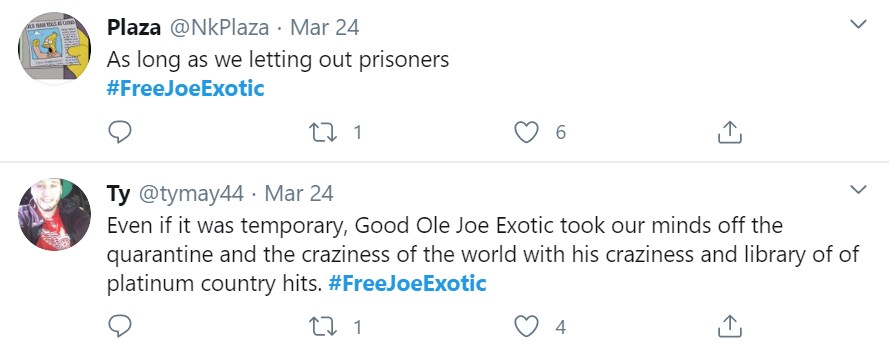
The following data contains samples of data collected from the first 10 tweets from an advance search on Twitter for #FreeJoeExotic starting from March 22, 2020 to March 23, 2020 and starting from March 24, 2020 to March 25, 2020. As you will see, there are some tweet from March 21 that showed up in the search. This may be a fault in the system, or perhaps the tweets showed up because they had engagement during the selected time. The reason isn’t relevant to the findings however, I wanted to make note of this to let my audience know that this was not a continuity error; these are the organic results from the search.

First glance at the data, the majority of people are either ‘Praising Joe Exotic’ or ‘Ranging about Carole Baskin’. I foresee that these tweet will be my biggest categories. Tweets that don’t dive into the hype like most will be coded as ‘Neutral’. There is one tweet thus far that specifically relates to animal rights issues. Surprisingly, this selection of data doesn’t contain any tweets that are against Joe Exotic. However, I do expect this to be another category while I continue collecting data.

Expected Code Categories

Praising Joe Exotic

Includes advocating for Joe Exotic, his release from prison, his brand i.e. G.W. Zoo, music, politics, etc.

Raging against Carole Baskin

Includes negative connotative about Carole Baskin.

Neutral

Includes neither full praising or raging.

Advocating for Animal Rights

Includes commentary regarding advocacy for animal rights issues i.e. references to the tigers wellbeing.

As I said before, this is only a sample of the data I will continue to collect and code by categories. In the process I expect more categories to reveal themselves. I will then use a quantitative method to find which categories are most popular, analyze their relationship to each other and pull all of this information to reveal what this all mean in the grand scheme of things.

I am particularly interested to reveal why society is so supportive of this demonstration of complete chaos. Especially during these panic-filled times, it is quite interesting that we see people admiring a man who is in prison for murder for hire. The magnitude of Tiger King’s virility doesn’t make much sense but neither does the toilet paper shortage. I am hypothesizing that the consumption of absolute chaos dilutes the current state of chaos people are existing in. The wild rampage of praising and raging about Tiger King across social media seems to be a means for connecting through social distancing.

Tiger King features several characters who walk the line between morality and legality, all of which cross the lines of both sides… and this is what people love about it. What does it say about society that this is the type of content that has viral spreadability? The entertainment industry is desensitizing us to unmoral stories and social media is intensifying it’s glorification. Did Netflix intentionally release a ‘limited series’ on Murder, Mayhem and Madness to diverge people from the larger issue at hand? Are people just bandwagoning the praise of Joe Exotic? Probably. Should we be concerned about this? Probably. Has the series had a positive or negative effect on society? Trends in the data collection should reveal the answers to some of these questions. We shall see…

The Search for Chaos

Hey all you cool cats and kittens!

Apparently, there’s no better way to cope with a pandemic than with complete chaos. To say ‘it is weird times we are living in’ is an understatement. To make it even more weird, for my research project I will be gathering data about how social media is responding to the Netflix documentary Tiger King. In result of this, I hope to reveal exactly how and why society is using Tiger King (a depiction of complete chaos) to cope with COVID-19 (more chaos).

Twitter is home to a plethora of Tiger King data. Specifically, I will be looking at tweets under #FreeJoeExotic. Netflix released Tiger King: Murder, Mayhem and Maddness on March 20, 2020 and it was until the 22nd that the hashtag was born. I will perform a quantitative advance search provided by Twitter’s platform to collect #FreeJoeExotic data beginning March 22. I will gather the first 10 tweets every other day for two weeks until April 4. Once this data is collected, it will then be coded and organized into categories. Finally, the data will undergo a qualitative and rhetorical analysis.

There is no evidence that this is the methodological best practice. However, there are some convincing elements to why I chose this method. First, I chose Twitter over other platforms because it is conveniently equipped with the advance search tool. This will let me go back in to search the time frame I have designed. Second, Tiger King sat as Netflix’s #1 show for 15 days straight from March 22 to April 6. The time frame of my data selection covers the window from when #FreeJoeExotic was born through its apex and fall. Third, a qualitative and rhetorical analysis is necessary to reveal why and how people are coping with Tiger King chaos.

Blame Ill Intention Not Social Media

There are social media problems and there are political problems. When they come together, the underlying nature of human intent is only intensified.

On one end, social media extends geographical boundaries to bring people together to share memories and ideologies. On the flip-side, social media can be a powerful tool of manipulation that spreads misinformation and encourages ideological and political polarization. Sometimes it seems like we see the latter more than not. The results of this poses a great threat to the American democracy. Rather than social media uniting people together, it is chipping away at The United States’ ‘unity’. However, I don’t think social media platforms should take all the blame.

Human Intent

When I was first thinking about the problem on social media and democracy, I was quick to blame social media for dividing people. After some research, I shifted my perspective to look at the root of the problem.

Social media itself is only a system. Blaming social media for political polarization is like blaming the gun for firing. It is not the gun that fires, it is the person that pulls the trigger that makes it fire.

The things we see on social media like misinformation and manipulation are not all that new. We are only experiencing them through a new medium that magnifies the problem. Facebook said it itself:

If there’s one fundamental truth about social media’s impact on democracy it’s that it amplifies human intent — both good and bad.

While social media may increase the influence of ill intentions, social media is not the root of the problem. The problem lays in the intent of the person running the system.

For instance, in the Cambridge Analytica and the 2016 election scandal, millions of Facebook profiles were hacked and utilize for political campaign advertisement. Not only was this performed without millions of people’s consent, but it was disrupted the natural system of American democracy. Social media worked as a tool to the ill intentions of the people behind the agenda. To my understanding, this notion is not all that new. How is it that different from legacy media and propaganda?

Social media is being used the same way the press can be used to push an agenda. Propaganda is as old as time. What is new is that politicians can buy their way in front of their desired audience with personalized persuasive content. If all the content is curated to catch our attention, how do you know if you really support someone or if you were manipulated into thinking that you support someone? We shouldn’t point a finger at the medium when it’s the people that are working through the medium. 

Intensified Intent

As I have identified in my past blogs, social media curates the content on your feed. So, we know the motives are in the eyeballs and the money. The motives for politics are that in of the same but with the result being a vote. When political campaigns take on social media, they have the potential to take advantage of the algorithms. Rather than organically reaching people, it is as easy as a few clicks to get reach your desired audience.

Casey Newton interviewed Ezra Klien in her article Why we can’t blame social media for our polarized politics. He said:

“I think the move towards algorithmic feeds that select for content that triggers an intense emotional response is just a bad way to structure communication. I think supercharging our social instincts often brings out the worst, not the best, in us — few look back fondly on the social dynamics of high school cafeterias, and for good reason.”

We see emotional backlash and intense polarization when things are miscommunicated or taken out of context to fit an agenda. There is not much we can do to alter deep rooted ill intentions or political corruption. However, social media corporations can design their products in a way that protects their technology from being taken advantage of. Of course, this would mean that they would have to have good intentions in the first place.

Issues like this need to be reevaluated with the moral duties of social media corporations. In a perfect world, they should fulfill a moral duty that has the consent of its users i.e. a “Designer’s Oath”.

What’s Next?

If things continue to go as they are with social media and politics, it may deconstruct democracy as we know it. In my case, the current dynamic has only pushed me further away from being politically interested. Lucky, I have not been pushed away from voting. But I am not proudly educated when I make my decisions at the polls. There is not enough trustworthy and easily accessible information. Also, I think it is important to remain skeptical of your ideologies being shaped by the information provided.

Let’s not give up our hope yet. The merging of social media and politics is still relatively new. Right now, politics are using social media to meet their needs whichever their intent are. Going forward, social media has great potential to work with politics. I would like to see both industries come together to establish a moral code that works for the people, not against them.

Where is social media headed?

Your phone can ding, and you’ll be latched onto it a split second. Before you know it, you’re stuck in a blue light void. Once we snap out of it, we wonder where all our time went but that doesn’t stop us from doing it again in an hour. Many of us are so use to this reality, we expect and accept it. Have we already given up?

In my last blog Attention Tension, I explored the concept of our attention being monetized. Here, I am going to talk more about the rights that consumers should have and introduce potential solutions for the future.

As consumers, we have virtually no control over the content we are see. The consumers should have more say in what they’re consuming. Yeah, we follow people and like things, but we only see about a small portion of that. The content we consume is based off the information algorithms analyze to be in our interests. Big tech companies analyze what we are interested in and just give us more of the same thing to ensure that we are engaging with the content

Remember when we were surprised and honestly a little creeped out when things you’d talk about with your friends would show up in Ads. Now, it’s just a part of the game, it hardly phases us. Come to find out, we “accepted” these conditions in that 15-page legal mumble jumble Terms and Conditions by clicking the box. But did we really have a choice? The Terms and Conditions system is very black and white. It’s either, you click the box to gain access to the app or you don’t click the box and you don’t get access to the app. There are no alternatives. And we don’t even have the choice to red line a digital Terms and Condition.

Designer’s Oath

Rather than subscribing to these frustrating Terms and Conditions, consumers should have more control over their attention and privacy. In Stand Out of Our Light, James William’s proposes the idea of social media designers pledging to a “Designer’s Oath”. William’s “Designers Oath” would look something like this:

As someone who shapes the lives of others, I promise to:
Care genuinely about their success

Understand their intentions, goals, and values as completely as possible

Align my projects and actions with their intentions, goals, and values

Respect their dignity, attention, and freedom, and never use their own weaknesses against them

Measure the full effect of my projects on their lives, and not just those effects that are important to me

Communicate clearly, honestly, and frequently my intentions and methods and;

Promote their ability to direct their own lives by encouraging reflection on their own values, goals, and intentions.

Stand Out Of Our Light by James Williams

Essentially, this would protect user’s privacy and attention. It would encourage a transparent relationship between the users and the developers. These boundaries are quite simple. Doesn’t it make you question why these rights aren’t being protected already?

This got me thinking… all social media can’t be like this? Someone must have come up with an alternative.  So, I started to dig.

Mastodon

It’s like Twitter but with more freedom. Rather than one overarching, large corporation servers controlling the curation and spreadablity of content, this power is handed over to the consumers. Cool, right?

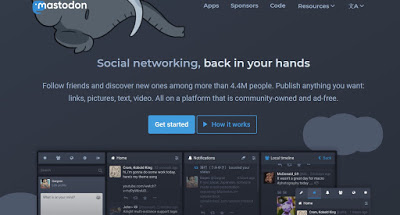
Mastodon is an open soured network or federated network. This means that there is no one entity controlling the content. You can think of it like we do emails. Users can connect with people inside and outside of their instance. If you use Google, you can still email a friend that uses Yahoo. Imagine Google and Yahoo were privately operated by ordinary people. We can think of them as site admins. Now, imagine they didn’t push Ads or analyze your media traces to come up with a formula that psychologically kept you online for hours. That’s Mastodon.

The developer of Mastodon, Eugen Rochko writes “It means that users are spread throughout different, independent communities, yet remain unified in their ability to interact with each other.

Mastodon is made up of several separate servers called “instances”. Users can sign up to create their own instance with their own rules. Each instance is owned, operated and moderated by the community. Users can be private or public. Instead of ‘tweet’, you ‘toot’ up to 500 characters. They also offer anti abuse tools to help users moderate bullies. When you toot, you have the options to make a content warning. There are no manipulative algorithms. The feed is listed in a chronological order. If a toot is worthy, your friends can ‘boost’ it to get more views.

It’s nice to know that alternatives social media platforms exist. However, I am afraid we are too far deep into our non-federated social media platforms that many could care less to switch over to a platform like Mastodon. While all these features sound great, I don’t think people have enough incentives to switch over. Many people have built an online identity on their regular platforms. It would just be more work to start over. The easy route is to simply flip the cognitive miser switch on and turn a blind eye to problems that exist in traditional social media platforms.

Maybe federated social media networks are the future of social media or maybe they’ll only exist in the shadows of corporate entities. Maybe we’ll just implement a “Designers Oath”. Whichever the future may hold, I hope it is something that gives more power to the people.

Clout Economy

How far will influences go in exchange for social media exposure?

Gift Economy

We have all been givers and receivers of gifts- Christmas, birthdays, and anniversaries. When a gift is given, there is an unspoken reciprocation to show appreciation and give back when the next occasion comes around.

In The Gift by Marcel Mauss, he presents the phenomenon of the “gift economy”. This is when something of value is given to a receiver without explicit agreement of exchange; it’s a mutual understanding of reciprocation. The transaction between people is both a means of building relationship in society and preserving relationships. This bounds society to the obligation to give, receive and reciprocate. Further, this idea is understood in totality to society as series of collective exchange processes.

I argue that Social media allows and even amplifies the collective exchange process. We post pictures online to receive likes, comments and shares. In turn, we like, comment, and share when other’s posts show up on our feed. Often, this obligation to give arises out of self-interest tendencies to show our superiority. You know, like your last birthday or anniversary post. You may think the action of sharing comes off as generosity, but maybe you’re only sharing for the sake of preserving your side of the relationship and your reputation as that role.

Rather than turn a blind eye, it’s important to recognize the gift economy merging with capitalism. For most people, the exchange of pictures and likes remains free, but for influencers, the exposure equates to money behind the scenes. So, we can think about this as a perceived gift economy and call it clout economy.

Clout Chasers  

Urban Dictionary defines Clout as someone who is famous and has influence. To gain this social standing, creators are expected to produce content that viewer deem “like, comment and share” worthy. Influences gain exposure and followers grow. This cycle continues until their growing following hits a plateau. They are putting out content but not receiving their desired response from the audience. Now they are in a dilemma. If influencers income is based off a perceived gift economy, but there’s no reciprocation happening, what do they do?

The easy answer is to do something with shock value. Something scandalous that will make people talk and get them media attention and unfortunately, this often involves infamy.

Let’s talk Tana Mongeau and the Paul Brothers.

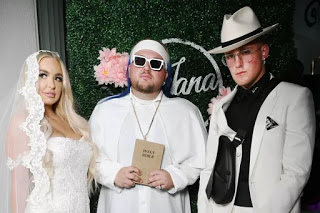
Tana Mongeau and Jake Paul are both influencers known for their tendency to chase clout. They started out as best friends. Then it turned into them joking about being in a relationship when Tana posted a YouTube video called “Muckbang In Bed with My Rebound Jake Paul”. From there, they ran with this idea, started dating, got married and broke up; all in the span of nine months.

It’s unclear if they did develop real feelings for each other over time but they did refer to their relationship as a “clout relationship”. So, they openly stated that they had the intentions performing a relationship in exchange for exposure.

They partnered together to sacrifice their relationship status for driving in exposure, attention and money. Essentially, a ‘clout relationship’ is a business strategy. Mauss recognizes that “morality is not solely commercial”, or at least, it shouldn’t be. The gift economy should not be just a means of upholding a reputation out of obligation. However, a clout relationship is structured off commercializing the reciprocation of a ‘moral’ relationship.  

But, wait, the clout doesn’t end here.

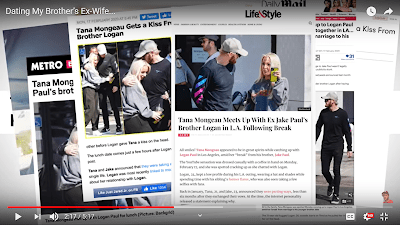
On February 20, 2020, Tana posted a video with Logan Paul, Jake Paul’s brother. Logan approached Tana with an idea to “get in a fake relationship, in front of the paparazzi and troll the entire internet”. Rather than stretching a relationship out across months, this was meant to only last about 48 hours. The goal put on a harmless prank to show the media that “everything they see isn’t always as what it seems”.

They carefully planned out their online gift exchange to prep the audience for their prank: Tana tweeted lyrics from her upcoming song “I know that it’s wrong, but I don’t care what’s right”, Logan favorited it and Tana posted a snap showing the corner of Logan bed. They would stage a date, give the media what they want, it would go viral and people would reciprocate the attention back to Tana and Logan.

Who’s to say if this is right or wrong, just a part of the game or going too far. There’s a lot to be concerned with here but most importantly is that this model of gaining attention relies on manipulating the public into giving back. Gift economy should be acts of generosity with only some level of self-interest. It should not be consumed by self-interest.

The Cancel Train

All aboard the Cancel Culture Train.

Call-Out Culture

Cancel culture originated from the “call-out culture” on twitter. Calling-out is drawing attention to perpetrators. It started out by confronting heavy issues, mostly relating to sexual assault and harassment. We first saw this trend in the music culture, from people tweeting things like “cancel R-Kelly” or “#MuteRKelly” in July of 2017 in response to his sexual assault accusations.

Next, a bulk of allegations towards Harvey Weinstein were made. Alyssa Milano posted on Twitter, “If you’ve been sexually harassed or assaulted write ‘me too’ as a reply to this tweet.”  Several women came out with their #MeToo stories. The notion of exposing the oppressors and perpetrators through call-out culture  lead to the #MeToo movement on October 15, 2017.

This was a healthy way to start conversation, facilitate empowerment and community for the victims. Not only did it start a trend to hold people of influence accountable for their actions, it laid the foundation for women to stand up and speak out against their #MeToo stories together. However, a shift in the rhetoric has lead society from this well-intended action to the more toxic notion of Cancel Culture.

Cancel Culture

Canceling is online phenomenon of rejecting, shaming and ostracizing a member of a community with a mob mentality. It results in manipulating one story into another, more dramatic story. Typically, it starts when a person of social standing is exposed by the masses for an inappropriate, insensitive or offensive behavior. Essentially, it’s an extreme vigilante approach of boycotting and humiliation.

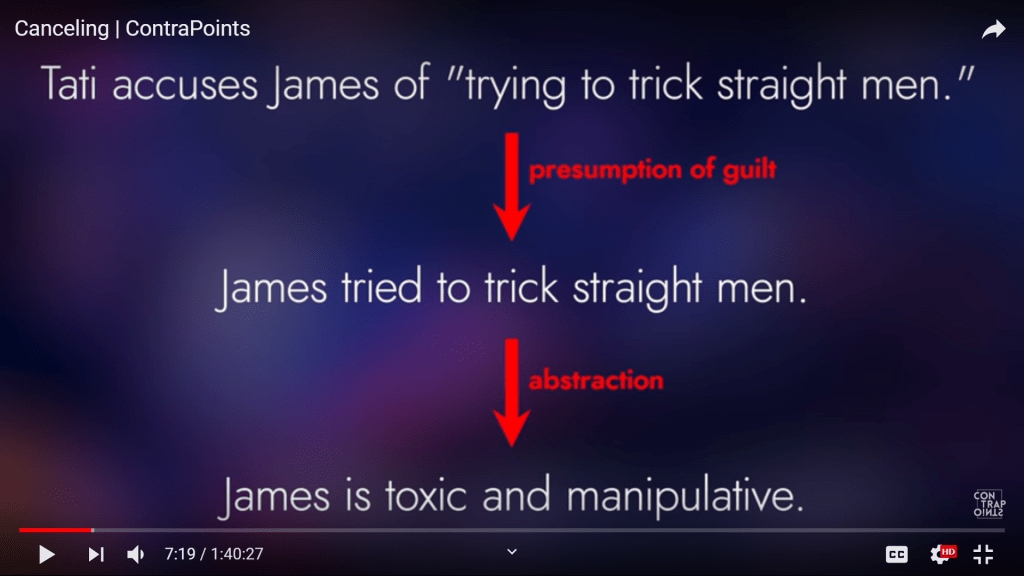
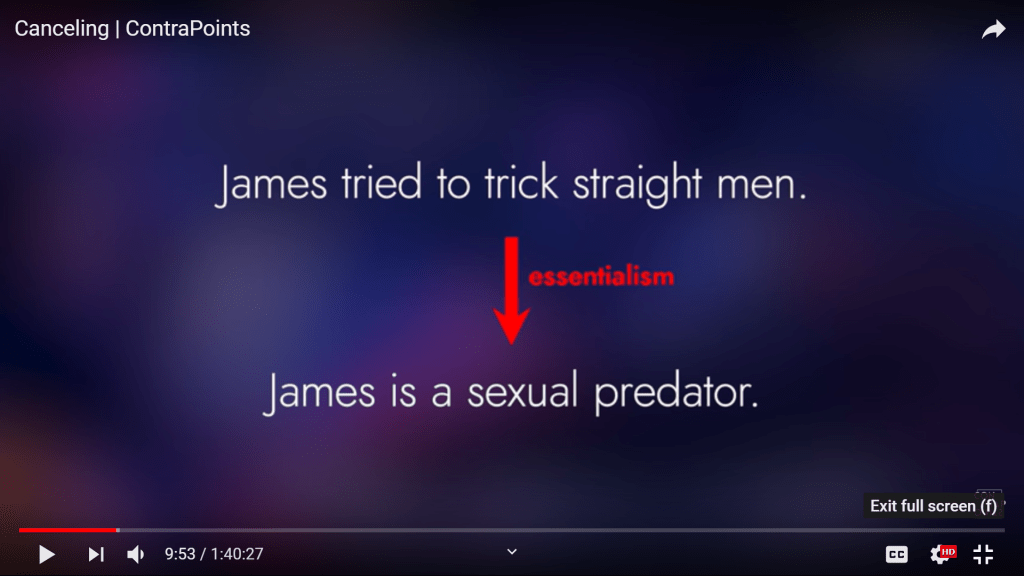
YouTuber ContraPoints made a video “Canceling” that explains how a comment makes its evolution from the Call-Out Culture to Cancel Culture. She explains this process through three Cancel Culture Tropes: Presumption of Guilt, Abstraction and Essentialism.

Presumption of Guilt is the belief that one is considered guilty unless proven innocent. This idea is exact opposite of Justice in the United States where one is considered innocent unless proven guilty. Next, Abstraction replaces the specific, concrete details of a claim. Here, the presumption of guilt becomes generalized to a characteristic of a person’s action. The final stage of Cancel Culture is Essentialism. This is shifting from criticizing a person’s action to criticizing the person themselves i.e. the biggest cancel of 2019: James Charles.

Further, there has been a shift in what people deem worthy of calling-out and the attitudes people have towards people who are #cancelled. So, rather than being an empowering movement, it is now just a giant hate train that bulldozes through people with no mercy. People nitpick for potentially controversy issues to instantly cancel people out of relevance with no questions, and no exceptions. This makes it hard for influences to redeem their social identity. Even a sincere apology, it isn’t good enough for the Cancel Culture mop to accept them back into society.

The Spreading of Cancel Culture

What is Spreadable media? You know what it is to go viral, right? Well it’s along those lines but without the negative connotation behind it. In Spreadable Media, Henry Jenkins says that we can think about spreadable media in the same terms that you spread you peanut butter and jelly across the bread. But with, media content and networks of friends, family and strangers across the web. In the simplest definition, it’s how media gets circulated so rapidly.

Jenkins explores the idea of spreadablity as a virus. We are all susceptible hosts to spreading content across media like click-borne contagions. If normal, innocent media is spreading faster than we dream of controlling, then that means so is the toxic, wrong informed, ill-intentioned media. And it’s always the black and white fallacies who are the first to reach their fame. We all know that the juicier the drama is, the better… am I right?

Lisa Aziz-Zadeh, Associate Professor at the Brain and Creativity Institution at USC explains that people make reactions videos because mirror neutrons allow people to reciprocate the emotions of the content they are watching. This connection to the content fills the void lacking human connection. So, we know what happens when people like content. But what happens when people don’t like what they see?

Naturally, cognitive dissonance arises when our values contradicted the values being communicated by others. Popneuro’s article, The Psychology Behind Cancel Culture says that we can resolve this tension in two ways:

By sticking with the celebrity and changing your values

By sticking with our values and changing our allegiance with the individual.

Popneuro

Our values are much harder to change so, almost always, without question, people choose to change their relationship to the celebrity. They become infected zombie-like, reputation eaters. They jump on the cancel train and spread traces of hate one click at a time.  And there’s no turning back in Cancel Culture. It’s all or nothing.

Golden Rule

This shift in rhetoric and attitude towards people who society deems as #canceled has eliminated the opportunity for healthy confrontation and conversation. It is appropriate and necessary to hold people of influence accountable for their actions. But by doing this through Cancel Culture only adds fire to the flame. Especially with consideration that media’s model of circulation is like a virus.

Rather than increasing their engagement by feeding into the Cancel Culture, why don’t you simply raise awareness of the issue? Rather, than aiming to cancel people, why don’t you just ignore them? Why don’t you message victims or perpetrators personally instead of publicly? Or just keep your opinion to yourself.

People make mistakes unintentionally and sometimes intentionally. But the point is that these are people too. Don’t you remember the Golden Rule? Treat people how you want to be treated.

Will you second guess yourself next time the Cancel Train arrives on your feed?

Social Meadia: Perfection by Design

Putting on a smile in times of pain; we are all guilty of it.

Mead tells us that as social beings we learn to cultivate and understand our identities in relationship to others. Social media gives us the power to curate our any identity in just a few snaps, taps and clicks. Before you know it, you begin to act in a certain way online to fulfill a facade identity. What happens when your reality doesn’t align with who people expect you to be?

Media Accounting

In Lee Humphrey’s book The Qualified Self: Social Media and the Accounting of Everyday Life, she explores the idea of social media accounting as a historically ritualistic process through socio-technical systems. In the 19th century, the diary was a daily, family documentation of mundane and eventful activities. This documentation of birthdays, holidays, anniversaries or moments of transition are annual practices of media accounting. The act of documenting builds media traces of our past life’s experiences. Media traces provide us with a physical form of remembrance.  

Sound familiar?  

In many ways, posting on social media is much like writing in a diary. Interestingly, diaries weren’t always considered to be a private act of daily reflection. In wasn’t until the 20th century, when American culture shifted to an individualist nature, that diaries were locked up and held hostage behind teenager’s doors.

They had often been read outload as an act of facilitating domestic conversation and connection. Families addressed any physical or emotional concerns with transparency.

Can you imagine all your secrets being revealed at the dinner table?

Media accounting was originally public and transitioned into a private practice. With the innovation of socio-technology, media accounting has transitioned back into the public view. However, rather than being a healthy form of connection, there is a lack of conversation on addressing real issues and personal struggles. With the absence of addressing these issues, people further suppress their struggles by designing the “perfect life” through their media traces and performing unaligned identities.

Performing Perfectionism

Business Insider met with Psychotherapist Allison Abrams, she explains that it is in our innate nature to compare ourselves to each other but social media amplifies our tendency to do so. A vast majority of people choose to display the most perfect and aesthetically pleasing moments of their life. To many viewers, this is interpreted as a constant reiteration of how their life isn’t living up to these perfect standards.

The performance of positivity and perfection is reinforced for a monetary value in the form of money or in the form of likes. Influencers are often contracted with companies to promote and/or review products.

They put on this face to appropriately represent other identities to make money but end up neglecting their own. Anna’s Analysis of Fake Positivity explains it nicely:  

Often, these influencers are dealing with their own emotional problems that they may feel like they can’t talk about because it would affect their reputation and how people view their advice. Or they may feel like people wouldn’t be as attracted to their content if they weren’t always upbeat and bubbly.

As mentioned before, we tend to understand our own identity in relation to others. It is much easier to put on a smile in fear of rejection or scrutiny. It is much easier to blend in to fulfill the shoes of what others expect of you, especially when your income and quality of living depends on it.

Digital Panopticon

This phenomenon that we must post the best representation of ourselves is so deeply ideologized into a conformative cycle of perfectionism. We can understand this in relation to Foucault’s Panopticon. The Panopticon is an architectural structure designed to reinforce self-discipline and social order through the imagined, constant surveillance of authority. In other words, he proves that people tend to conform to the expected behavior when they think they are being watched by others. This is an accurate explanation for why we conform to the perfection performed by others.

We see this problem most prevalent in Instagram and YouTube influences. Their ‘come-up timeline’ always starts with them bringing something unique to the table that is relatable or at least interesting. Whether that be their personality, authenticity or niche, it jumps starts their following and fame.

Surprise… being unique is good and this is what viewers want.

When they finally make it, many start to blend into the scene. This comes in fear of losing the social status they have spent so much time curating online. And all of a sudden, they ‘aren’t relatable’ or ‘authentic’ anymore.

Life Update

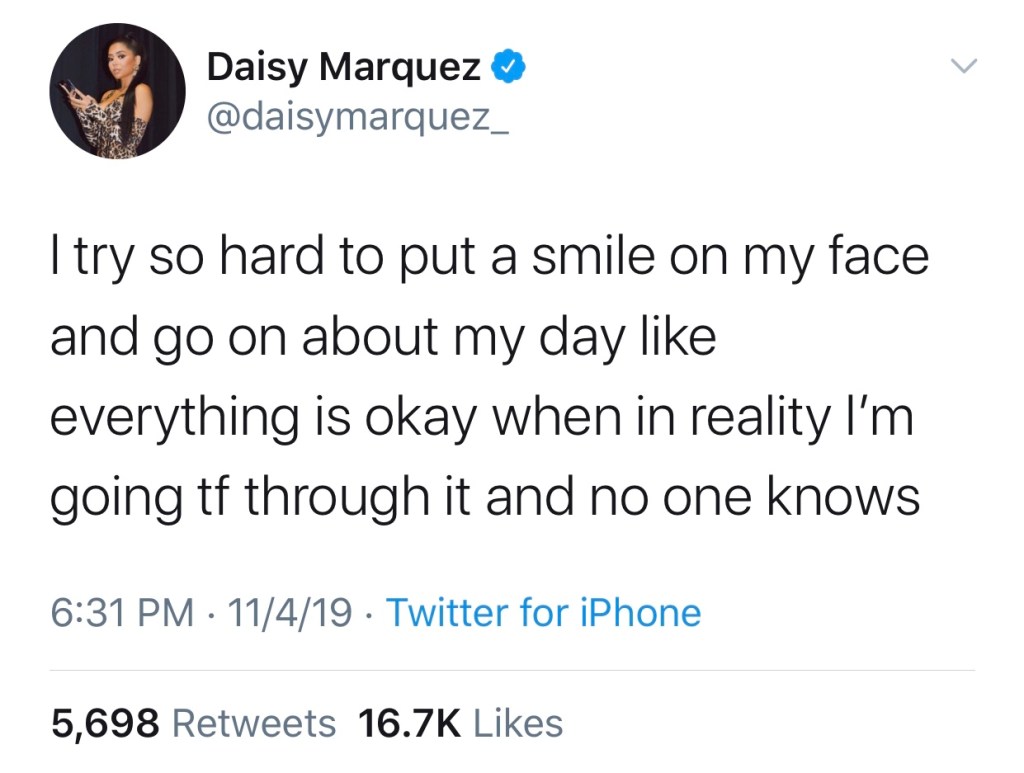
This is incredibly painful to feel unaligned with an identity you’re meant to keep playing. YouTuber and Influencer Daisy Marquez is only one example of the unspoken reality within the industry. On Twitter, on November 4, 2019, she posted:

Comments of support flooded her feed, but nothing was addressed further than this snippet of her personal struggles. Daisy posted this eleven days before she posted her “life update…” video. That’s a long time to be sitting with these dark emotions and that’s only a fraction of the time frame. In this video she confesses how depressed she has been behind closed doors.

It was so bad to the point that her hair was falling out… literally, she shows a bald spot.

Daisy admits that she’s been struggling with depression and anxiety for months and nobody has known because she keeps a smile on her face and goes through the motions of keeping up with her social media identity. To separate herself from her ‘LA’ identity she announces that she has made the decision to move back to Texas “to find her roots”.

While venting to the camera she discovers that the reason she feels like a “failure” is because she has “succeeded in everything [she] has wanted in life but [she hasn’t] succeeded at being happy”.

This is the sad truth of today’s social media perfection culture.

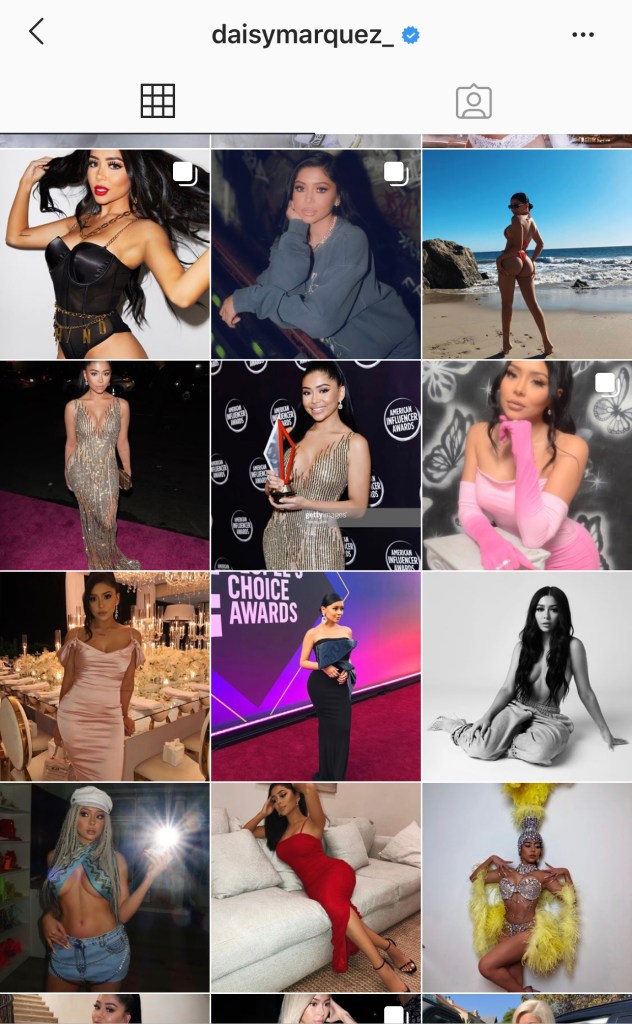
In the eyes of the digital panopticon, influencers feel the need to live up to an unrealistic standard of a ‘perfect life’. When the truth is, everyone has hard times. Life isn’t always margaritas on the beach, photoshoots and People’s Choice Awards. Perfectionism is only a constructed design. As a society transitioning from the private to publics means of media accounting, we haven’t adapted to displaying authentic representations of our lives.

The problem with performing perfectionism is that it only fulfills a surface level identity. Yeah you looked snatched in that picture but how were you feeling behind the lens? That’s what matters.

Design a site like this with WordPress.com
Get started